
A ‘vision’ for affordable, frequent, low emission travel
In late February 2026, two important reports were issued. One was released by the New Zealand Infrastructure Commission, Te Waihanga. The other was issued by a consortium of Forest & Bird, World Wildlife Fund and Greenpeace. Both talk about rail. One has a vision of creating an accessible, affordable, convenient, low emission way of getting around New Zealand without needing to drive or fly. For locals and tourists. For the able bodied and the disabled. The Commission does not use this type of language. Instead, it talks about ‘drivers’ behind the need to invest in transport infrastructure, the main ones being decarbonisation, slowing income and population growth. However, there is an overall message in the report to use existing infrastructure, including rail, more efficiently.
POLICYRESILIENCECLIMATE CHANGEPLANNINGREGIONAL RAILINFRASTRUCTURETHE FUTUREINVESTMENT
2/22/20268 min read
In late February 2026, two important reports were issued. One, with the title National Infrastructure Plan: Mahere Tūāhanga ā-Motu, was released by the New Zealand Infrastructure Commission, Te Waihanga.
The other was issued by a consortium of Forest & Bird, World Wildlife Fund and Greenpeace. Its title is A shared roadmap to building a nature positive Aotearoa.
The infrastructure report was widely discussed both in mainstream and social media. The ‘shared roadmap’, never really caught the attention of the wider media.
The infrastructure report is portrayed as a very thoughtful, measured stock-take with a potential way forward for investment in New Zealand’s infrastructure. It appeared to have been prepared primarily by economists and engineers. It is not a ‘vision’ document. However, it is informed by social and economic trends such as an ageing population and the need to reduce emissions.
Not surprisingly, the ‘roadmap’ report is seen by many as simply an advocacy document, full of ‘vision’ but without the hard-nosed lens of engineers and economists.
I see both as important and both should influence our thinking, especially in the area of transport. In this analysis we consider what both reports say about supporting the revival of passenger rail.
The ‘shared roadmap’, perhaps an unfortunate title as it was less about roads but more about low emission, low energy ways to travel, has five transport recommendations. These are:
1. Repurpose motorway expansion funding for a programme of investment in public transport, including electric rail, busways, cycleways, and regional rail links such as an overnight Auckland-Wellington service.
2. Stimulate active transport quickly and affordably by re-allocating some existing vehicle lanes to cycling where appropriate.
3. Introduce free public transport fares for Community Service Card holders, under-25s, and Total Mobility Card holders and their support people.
4. End new airport expansions and curb demand for private jets and helicopter pads.
5. Set a timeframe to end the import of fossil fuel vehicles, re-introduce fuel efficiency standards, and build a nationwide EV charging network.
The Future is Rail agree with all these recommendations. However, we are much more ambitious vision for rail. This includes reviving passenger rail across the whole of the ‘Golden Triangle’ and bringing back passenger trains to service Christchurch, Dunedin and Invercargill.
The Infrastructure Commission report starts off by praising some of the work of the past.
“New Zealand has delivered world-class infrastructure before. With tremendous innovation, hard work and skill, our ancestors knitted the country together with networks of roads, railway lines, tunnels and bridges.”
But when considering recent and future transport projects, it quickly warns (pg 11):
“New Zealand spends more on land transport than any other infrastructure class, yet current investment plans exceed what can be sustainably funded by users. Without stronger prioritisation, this risks displacing investment in other sectors and increasing pressure on general taxes. Reform is needed to better align transport investment with what users can fund, supported by clearer and more independent oversight to ensure spending is focused on maintaining existing networks and delivering new projects only where they respond to demand and provide clear value for money.”
It is worth noting, that the evaluation of RoNS does not fall within the orbit of the Infrastructure Commission. But the Commission is clearly worried that many of the proposed roads do not meet value of money type analyses.
On page 66, the Commission specifically notes:
New Zealand’s major transport project pipeline has grown much faster than the funding available to deliver it. This includes plans for 17 Roads of National Significance (RoNS), major rapid transit projects such as Auckland’s Northwestern Busway, and a new Waitematā Harbour Crossing. Taken together, these ambitions far exceed the revenue likely to be available over coming decades.
The Commission report sets out 10 priorities for investment across different sectors. Noted here are the ones related directly or indirectly to transport.
1. Implement time-of-use charging and fleetwide road user charges: This is essential for improving the efficiency of our urban road networks, particularly in congested cities.
2. Prioritise and sequence major land transport projects: Restore affordability by timing major road and rapid transit investments based on demonstrated demand and cost benchmarking, while using low-cost and targeted improvements first to lift network performance.
3. Manage assets on the downside: Actively plan for declining demand scenarios arising from changing demographics, technology and climate change, and explore asset recycling opportunities within portfolios to maintain value and affordability.
4. Prioritise adequate maintenance and renewals: Central government agencies must prioritise adequate funding to prevent asset deterioration and costly reactive fixes.
5. Identify cost-effective flood risk infrastructure: Climate change will intensify flooding and impact infrastructure, requiring effective community risk management approaches.
6. Commit to upzoning around key transport corridors: This will lead to more efficient use of water and other networks and maximise the value of transport infrastructure investments.
7. Take a predictable approach to electrify the economy: Achieving electrification and net zero carbon targets requires predictable market rules and policy settings rather than non-commercial government investment in electricity supply.
While airports are mentioned a couple of times in the report, the Commission does not address the major expansions of airports across New Zealand, nor the need to decarbonise aviation. This is surprising as one of the main ideas for decarbonising aviation is the production of alternative aviation fuels (AAF) which, if carried out within New Zealand, would involve significant direct infrastructure investment and would have major implications for land use and the energy sector. Some proposed AAF projects using forestry waste, as well as other energy projects, would increase the use of rail, given its cost-effective way of moving large volumes of wood.
Prominent rail and wider transport expert, Michael van Drogenbroek, has made some comments on the Commission report in a Linkedin post.
On a technical issue, he makes the point that the Commission seems to believe that rail has an emissions problem. It is correct that only a relatively small proportion of New Zealand’s rail network is electrified, but trains already have much lower emissions than trucks and cars when moving people and freight as illustrated by research carried out by the Ministry of Transport:
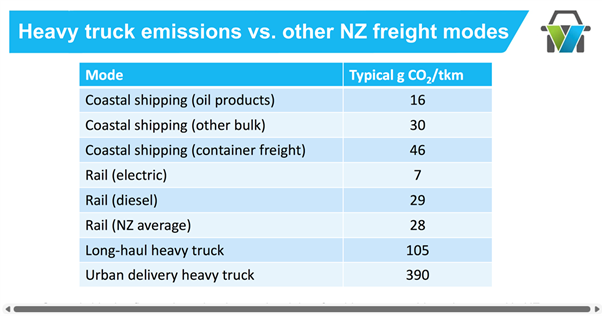
Commenting on this issue, van Drogenbroek notes:
“From next year NZ will have amongst the newest locomotive fleets anywhere in the world - with most of our fleet under 10 years old - most of the South Island fleet will be new (DM’s from Stadler), relatively new DL’s from China - and newly refurbished EF electric locomotives for the NIMT.
Also in a few years we’ll have the first Battery Electric Multiple Units trains in the Southern Hemisphere.”
The Commission report states:
“Central government has primary responsibility for funding below-rail assets, which currently run at a significant loss. The cost of maintenance, renewals and improvements is estimated at an average $500 million per year over the coming decade. While there may be a case for subsidising rail, doing so requires demonstration that the benefits of investing in rail exceed those offered by other public infrastructure investment opportunities.”
But, as Michael van Drogenbroek notes in his post
“That’s a fairly negative take on Rail - but it will continue to need to do better on telling its story. It’s made good progress on this in recent years with the 2024 EY / ARA “The Benefit of Rail to New Zealand” report as seen here for example”
A key chart van Drogenbroek highlights from the report is this one.
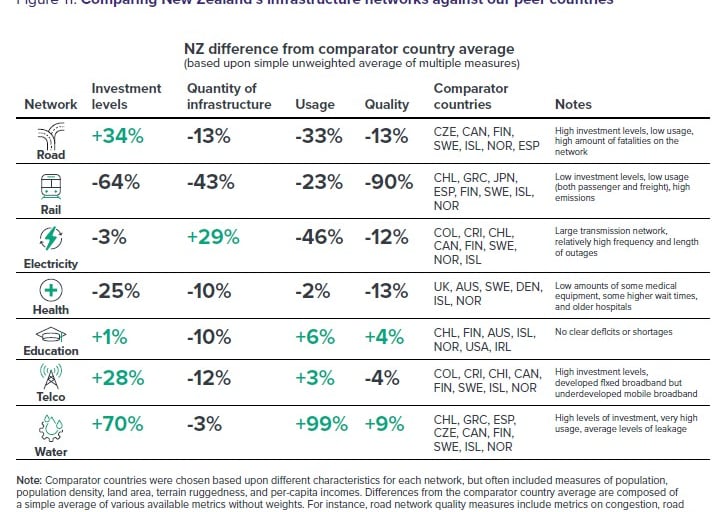
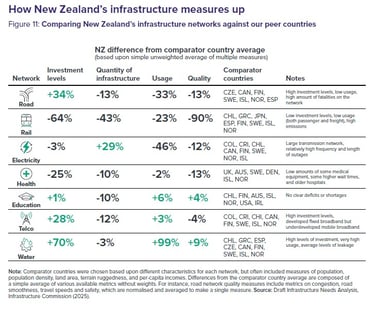
When comparing with other similar nations, we overspend on roads and underspend on rail. While the chart notes low usage of rail in terms of passenger and freight use, on the ‘overspent’ roads there is also comparatively little use.
The joint Forest & Bird, World Wildlife Fund and Greenpeace report recognises this and suggests a rebalancing of spending. In contrast, the Commission does not put forward any direct ideas for better using our rail network.
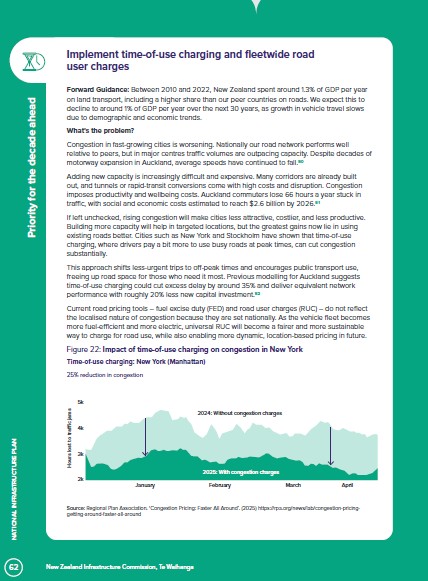
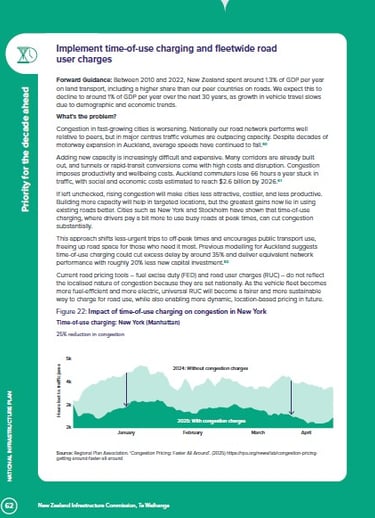
It does, however, put forward ideas that would help balance incentives for using roads versus rail. One idea is congestion charging.
The Future is Rail has also put out a report showing trucks do not pay for the full costs of damage to roads. One of the key conclusions is that maintenance costs have got away on our national roading network. The first tranche of the RoNS programme has proven to be insufficiently funded for ongoing maintenance. Out in weather exposed regions, regional highways and local council funded roads are struggling to stay open. While weather events certainly play a big role, it has been demonstrated through the report, that regional highways with their lightweight chip-seal construction philosophy, on our soft and unstable terrain, are not designed for substantial numbers of heavy trucks.
Meanwhile, the current government has acknowledged the solid work that KiwiRail is doing, to enable a more resilient rail network, better able to withstand weather events. In a separate post, van Drogenbroek recorded this comment from the Minister of Railways :
"That the Rail sector, which has spent 61 cents in every infrastructure dollar on maintenance and renewals in recent years, and is now forecast to spend 75 cents, is the stand out example of good asset management thanks to a no-nonsense approach".
While there is more work to be done given ongoing and future weather events, KiwiRail is already demonstrating how to cost effectively upgrade and maintain a resilient national freight network. The economic case, and a social equity and connectivity remit, must surely support the argument to maximise rail investment by commercial levers to bring more freight onto rail, and also to support regional passenger rail, starting with Auckland – Hamilton – Tauranga.
As a transport advocacy group, The Future of Rail has a vision of creating an accessible, affordable, convenient, low emission way of getting around New Zealand without needing to drive or fly. For locals and tourists. For the able bodied and the disabled. The Commission does not use this type of language. Instead, it talks about ‘drivers’ behind the need to invest in transport infrastructure, the main ones being decarbonisation, slowing income and population growth. But it also mentions the impact of an ageing population on wider infrastructure decisions, such as hospitals. There is an overall message in the report to use existing infrastructure more efficiently.
Yet, despite seeing decarbonization of transport being a goal, and suggesting our existing rail network has been under invested in when compared with other nations, in its report the Commission does not strongly support rail as being the most efficient way of moving people and goods long distance. This lack of support was also shown by the Commission rejecting The Future is Rail’s application in last year’s Infrastructure Priorities Programme to bring back a Southerner train service. This service would have primarily used existing underutilized rail infrastructure.
It is a pity the vision of Forest & Bird, World Wildlife Fund and Greenpeace is not backed by the Infrastructure Commission.
Postscript:
Coincidentally, and in parallel with this blog being posted, Michael van Drogenbroek was interviewed by Catherine Ryan on the programme RNZ Nine till Noon. Much of the good work that KiwiRail has been doing to enhance resilience across the national network, threatens to be undone by the government’s reduction of funding in the Rail Network Investment Programme (RNIP) by $200 million per annum. This is a shocking waste of the considerable skills that have been developed to demonstrably deliver cost effective maintenance and resilience.
The outcome of a reduction in maintenance and resilience funding for vulnerable regional railway lines can be illustrated by the destruction of the Napier to Gisborne rail line. A failure to maintain and manage culverts a very moderate cost per year, ultimately cascade to the catastrophic damage that has led to the loss of this line. Recent funding to maintain and build resilience in the national rail network is ‘chump change’, relative to what it will cost to maintain roads used by heavy trucks, carting tonnage that used to go by rail.