
Fast-tracking rail improvements in the Lower North Island
KiwiRail has submitted an application under the Fast-track legislation to carry out a series of projects to support the new trains replacing the Capital Connection and Wairarapa services as well as establishing better services for local commuters. It would also support potential revival of other services such as a night train from Wellington to Auckland plus trains to New Plymouth and Napier.
POLICYRESILIENCECLIMATE CHANGEWELLINGTONPUBLIC TRANSPORTREGIONAL RAILINFRASTRUCTURETHE FUTUREINVESTMENT
Paul Callister
12/11/20253 min read
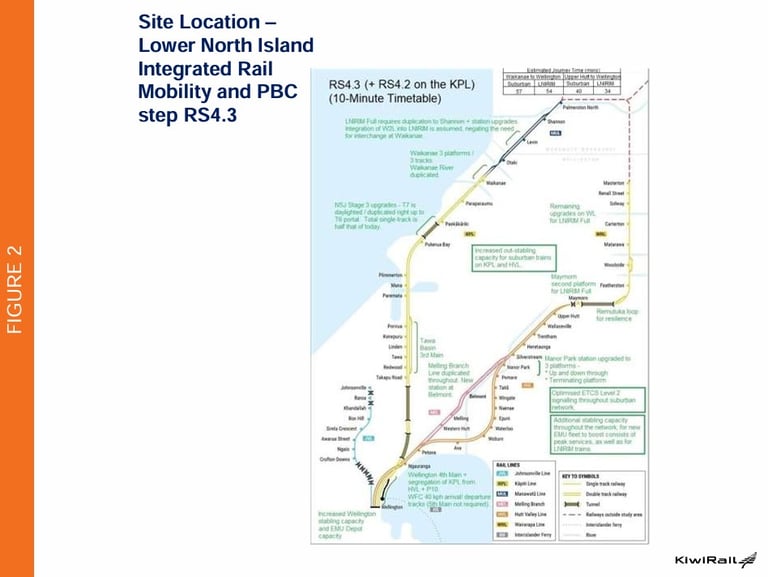
KiwiRail has submitted an application under the Fast-track legislation to carry out a series of projects to support the new trains replacing the Capital Connection and Wairarapa services as well as establishing better services for local commuters. It would also support potential revival of other services such as a night train from Wellington to Auckland plus trains to New Plymouth and Napier. The full title of the application is ‘Lower North Island Integrated Rail Mobility (LNIRIM) and PBC stage RS4.3’
The application states:
‘The project comprises rail network improvements needed to facilitate the LNIRIM programme of new trains for the Wellington region, as well as a meaningful initial step in the Wellington Programme Business Case (PBC) rail investment programme for the next 30 years. The network improvements involve track, stabling and station upgrades between Wellington and Palmerston North, and between Wellington and the Wairarapa.’
Their list of improvements in the application are:
• Wellington throat capacity improvements, including a fourth main to enable the operational separation of Hutt and Kāpiti services, northern access to EMU stabling, and separated access to the Wellington freight terminal, which will significantly reduce conflict between passenger and freight services and improve network and service resilience and reliability.
• Full duplication between Pukerua Bay and Paekakariki (North-South Junction), a key single-track constraint with several tunnels, and addition of a third main in the Porirua-Tawa area, will enable higher passenger frequencies and improve service resilience and reliability on the Kāpiti Line. This will make rail a more attractive travel option on that line, where population growth is expected to be highest, and ensure continued freight access the network as passenger frequencies increase.
• Duplicated approach to the Waikanae Station, including a bridge and second platform, which will reduce conflict between passenger and freight services, improve service resilience and reliability, and enable higher passenger frequencies on the Kāpiti and Manawatū lines.
• Extension of the Melling Line to connect with the Wairarapa Line at Manor Park station via a double track Manor Park to Melling link. Allowing significant journey time improvements on the Hutt Valley Line in addition to increased train frequencies from a 20 to 10 minute pattern. As part of this work, a new rail station would also be added at Belmont to increase coverage of the network and improve access to public transport.
• Duplication of main lines between Otaki and Levin: Adding an additional main on the NIMT in this area allows for further expansion of inter-regional services beyond what is provided in the LNIRIM programme (roughly doubling the number of services running between Palmerston North and Wellington), while preserving reliable and efficient freight access.
• Tawa Basin third main: Adding a third mainline track between Porirua and Takapu Road is required to ensure that competitive travel times and reliable freight access is maintained when the timetable moves to a 10 minute pattern. Without this infrastructure, a significant reduction in journey times would be expected, particularly for the limited stop services from Waikanae and Palmerston North, which would negate the benefits of moving to a higher frequency service.
• Network resilience and operational flexibility upgrades, including improvements to slopes, bridges, culverts, track infrastructure, areas subject to sea level rise and storm surge, and operational patterns and maintenance, which will make the Wellington rail system safer and more resilient, particularly in the face of climate change, and ensure that it can recover quickly when events occur to minimise customer impact.
• Network re-signalling, which will remove restrictions on the number of peak hour services, safely enable future frequency improvements, and improve operational flexibility, resilience, and reliability.
• Traction power upgrades, including additional substations and wider enabling power network upgrades, which will overcome current limitations and enable higher future train frequencies.
• Rail network segregation at all places where reasonably practicable, including improved fencing and grade separation of pedestrian and vehicle level crossings, which will significantly improve safety and the experience of surrounding communities as frequencies increase.
• Rail station and platform improvements at Maymorn, Manor Park and Waikanae, to support increases in rail volumes
• A passing loop in the region of the Remutaka tunnel to improve timetable resilience
• Additional stabling capacity, for storage and servicing of the increased fleet of passenger trains needed to deliver service frequency improvements.
If the projects are approved, actually carrying out all of them is dependent on securing the necessary funding. In the current environment most transport money is destined to go into Roads of National Significance including the proposed work in Wellington which is designed primarily to get people to the airport ten minutes quicker. At a time when we should be working hard to reduce transport emissions and investing in low energy ways to move people, the proposed rail upgrades are a far better set of projects.
For more information see: