
Te Huia: a bright future
The Future of Rail believes Te Huia has a bright future if current challenges can be overcome and an improved service receives the investment it deserves.
POLICYWAIKATOPUBLIC TRANSPORTPLANNINGINFRASTRUCTURECONNECTIONTHE FUTUREREGIONAL PLANSINVESTMENT
The Future is Rail
2/3/20263 min read
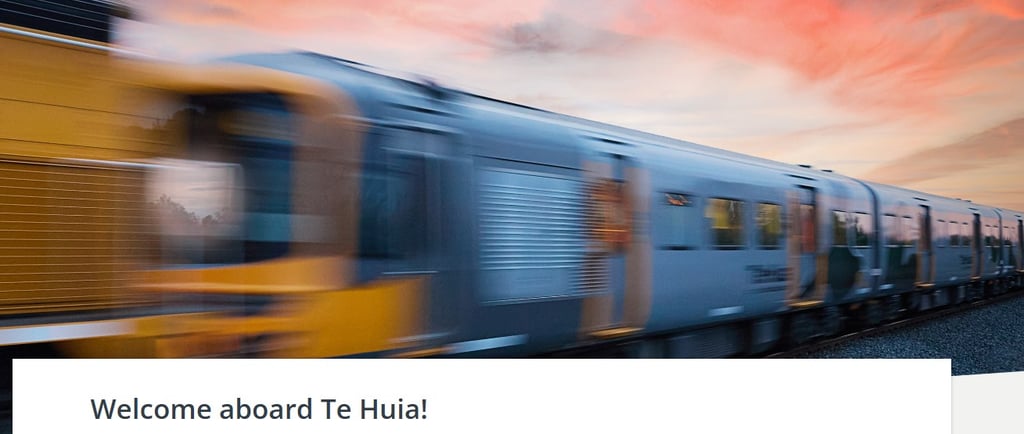
The Future of Rail believes Te Huia has a bright future if current challenges can be overcome and an improved service receives the investment it deserves. Passenger rail has a great future in Aotearoa New Zealand if failure is no longer baked into thinking about rail.
The Future is Rail has expressed our support for the letter from Warren Maher, Chair of the Waikato Regional Council (WRC), to NZTA dated 10 December 2025, as presented in the Council meeting agenda on 18 December 2025. Specifically, we highlight his closing statement: “Council is very grateful to NZTA for its continued support for Te Huia and hopes that this request for a one-year trial extension at 60% FAR will be considered at your Board meeting in February 2026.”
Making Te Huia a better service
An independent review, conducted by consultant Heriot-Edievale, was commissioned to identify opportunities for reducing operating costs, increasing revenue, improving farebox recovery, and reducing taxpayer subsidy. The review recommended several actions and concluded that: “whilst there are several challenges, Te Huia has significant potential to be a high-performing, long-term train service”.
In mid-2024, public transport expert Darren Davis had also set out ways to improve the service in a number of blogs including one republished on the Greater Auckland blog site. These were:
1. More station stops in the Waikato
2. More frequency
3. Better bus connections at both ends
4. A station stop in Pukekohe
5. Auckland paying its fair share
6. The need for more speed
Since then, the station stop at Pukekohe and greater frequency have become a reality.
In a late 2025 blog, Making Te Huia a permanent service, Darren gives further thoughts on how to improve the service.
In another study, the ability of trains to carry bikes opens up new opportunities for regional cycle tourism, including biking along the Waikato river trails.
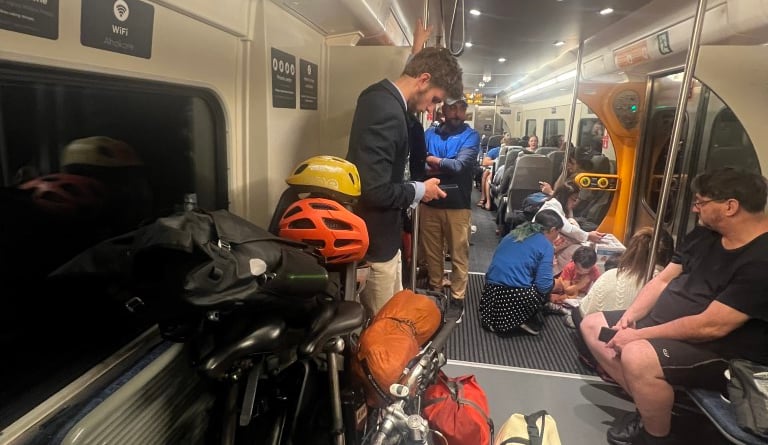
A further positive development is the Tūhono train contract for Lower North Island trains, announced in the 2025 Budget - co-funded by the Government, Greater Wellington Regional Council and Horizons Manawatu Regional Council, allows for future cost reductions on similar rolling stock within a specified time frame. This contract leverages Alstom’s battery-electric multiple unit (BEMU) technology, offering significant potential cost savings in procurement and maintenance for future rail projects in New Zealand.
With good access to around 85% renewable electricity across the motu, and relatively short journeys, Aotearoa New Zealand is uniquely positioned to build a regional rail passenger network using a mix of batteries and re-charge stations, and overhead power, where it is available.
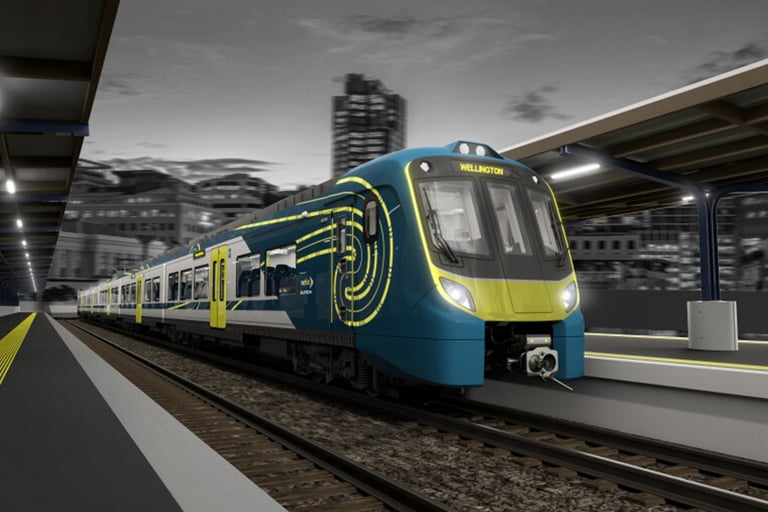
The new Tūhono Lower North Island local narrow-gauge trainset are powered by batteries and 1.5kV DC mains power. Each train-set has capacity for 233 passengers and two wheelchair users. In addition, there are flexible spaces for prams and bikes, and a vending machine for snacks and cold beverages. It is envisaged that the Tūhono design could be adapted to other configurations such as different internal layouts, battery plus 25kV AC mains power in the central and northern North Island, or exclusive battery operation in the South Island. They will also be able to accommodate slightly different station platform layouts across Aotearoa New Zealand (image c/o Metlink, Greater Wellington and Horizons Regional Councils).
We explore these issues in more detail in our report Preventing another Te Huia extinction.