
Te Huia: aligning future funding with land use
Thomas Nash, formally a Wellington regional councillor and transport chair for Greater Wellington Regional Council, notes that ‘Railway stations are the anchor points for some of the world’s most beautiful, accessible, exciting and well connected neighbourhoods, often hugely desirable places for people to live and work.’ Transit Oriented Development could play a key role in achieving net zero carbon emissions by 2050. It can help shape urban mobility patterns and demand through better integrating transport, land use and urban development planning.
WAIKATOPOLICYCLIMATE CHANGEPUBLIC TRANSPORTBAY OF PLENTYPLANNINGREGIONAL RAILINFRASTRUCTURETHE FUTUREREGIONAL PLANSINVESTMENT
The Future is Rail
2/17/20267 min read
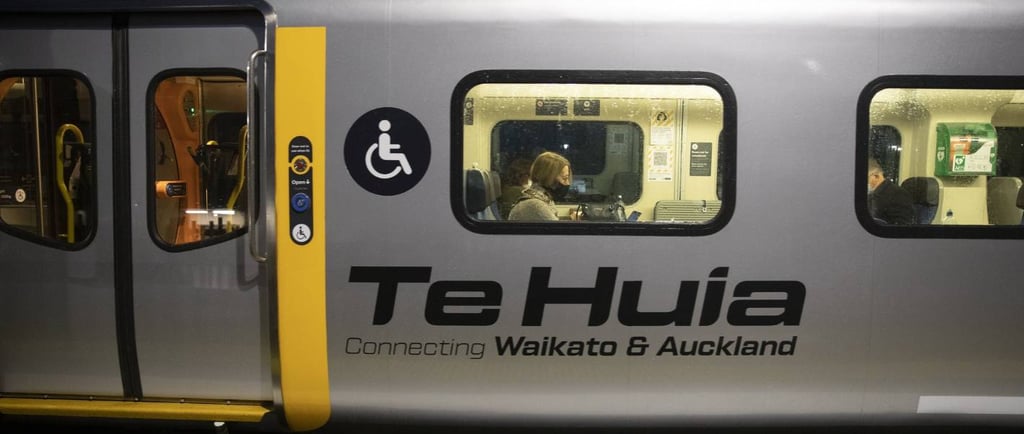
This is the final blog in a series of six arguing why retaining and expanding Te Huia services is important.
A key reason for the extension of Te Huia trial period is that any NZTA decision to co-invest in a permanent train service, through the 2027–2030 National Land Transport Plan, would likely be at the normal 51% FAR. As stated in the WRC Chair’s letter, the “Council commits to consulting with the community about the future of the service and increased local share costs via the 2027–2037 Waikato Regional Council Long Term Plan process”. An additional year’s trial would provide more time for NZTA and WRC officials to conduct the technical and business case work necessary to support future funding bids and decisions regarding Te Huia rolling stock options.
One key area not directly addressed in the current and future business case for Te Huia is alignment with transit-oriented public and private sector property development. The merging of Transport, Housing and Environment into the Ministry of Cities, Environment, Regions and Transport (MCERT), provides the opportunity to align transport investment with regional planning, housing and infrastructure. A first for New Zealand, this strategic alignment could be a game-changer for passenger rail, in a similar manner to the way that the South East Queensland rail network has supported the growth of that region.
Acknowledging decades of lost opportunities in general, it was interesting to note that at the announcement of the new ministry, Minister Chris Bishop had this to say about the City Rail Link;
“I have spoken often about how City Rail Link, which will open next year, has been a real missed opportunity for New Zealand. It will be a transformational project for Auckland once open, but it presents opportunities across land use change, infrastructure funding and financing, and urban development which have either not been taken up or are only now being belatedly explored. My firm view is that the disconnected nature of central government policy advice has contributed to those missed opportunities.”
This is reinforced by the 2026 National Infrastructure Plan: Mahere Tūāhanga ā-Motu, published by the New Zealand Infrastructure Commission | Te Waihanga in February 2026.
Point 9 of ten priorities for the decade ahead is:
Commit to upzoning around key transport corridors: This will lead to more efficient use of water and other networks and maximise the value of transport infrastructure investments.
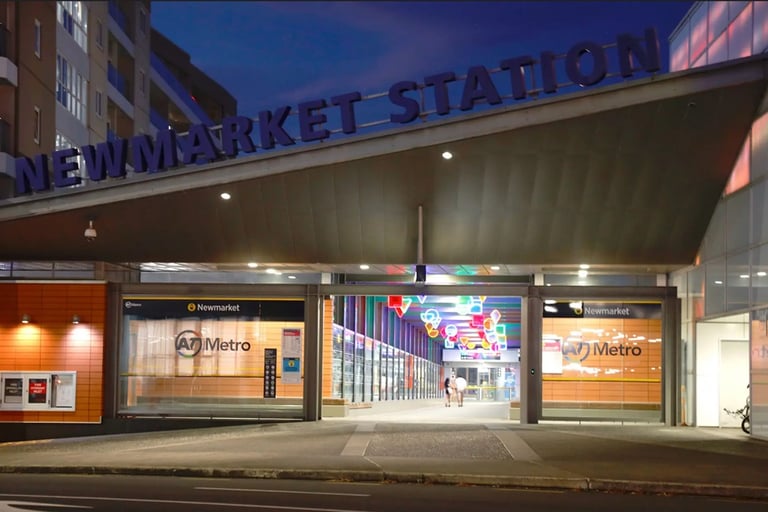
Newmarket Station is a key station on the Auckland Metro rail network. At one-point KiwiRail and its predecessors owned considerable land around Newmarket Station and other locations. Did the Auckland rail network upgrades ever receive a developer contribution, valued as an economic benefit within the integrated business case supporting those network upgrades? Or was the land was sold, with the developer benefitting from the rail upgrades, but with no rent or fees coming back to KiwiRail, as original owner of that land.
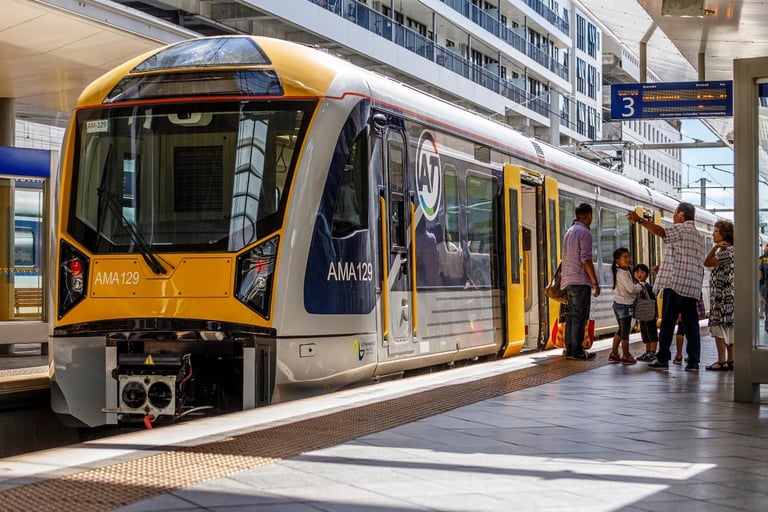
While perhaps not perfectly optimising the potential value of Transit Oriented Development, Newmarket station and town centre nonetheless clearly demonstrate the successful working dynamic between a railway station, retail shopping and housing.
In South East Queensland, the state government Department of Transport and Main Roads (TMR) has a strong focus on Transit Oriented Development (TOD), and a number of successful projects big and small have been completed, are under construction, or planned under TMR leadership.
Amongst the TMR TOD projects, Ferny Grove is a current suburban rail terminus development. The department sought the involvement of the private sector in the planning, design and delivery of a mixed-use TOD outcome at the Ferny Grove train station and transport interchange, featuring residential, retail and office spaces. The operator, Queensland Rail, the developers , and construction company are all key stakeholders in what is a high-calibre, integrated development. The development is expected to be completed in late 2026.
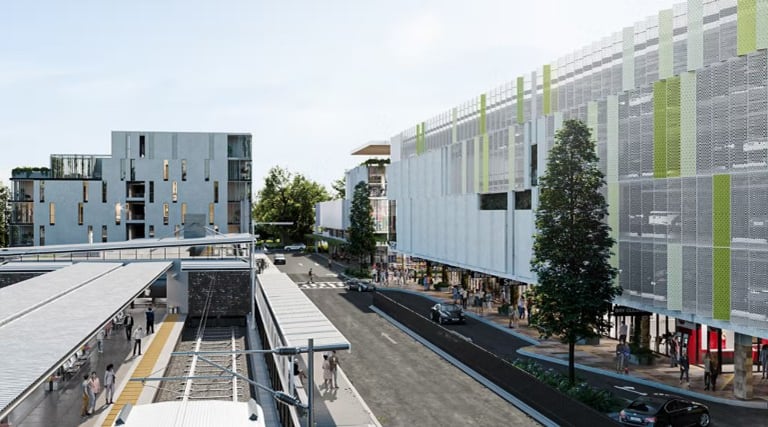
Led by the state government Department of Transport and Main Roads (TMR), Ferny Grove is a mixed-use TOD outcome at the Ferny Grove train station and transport interchange. The station is envisaged to cater for more than 5,000 passengers per day from the end-of-the-line transport hub, and the development is to include 1,400 carparks. The hub also connects with the scenic cycleway to Samford Village.
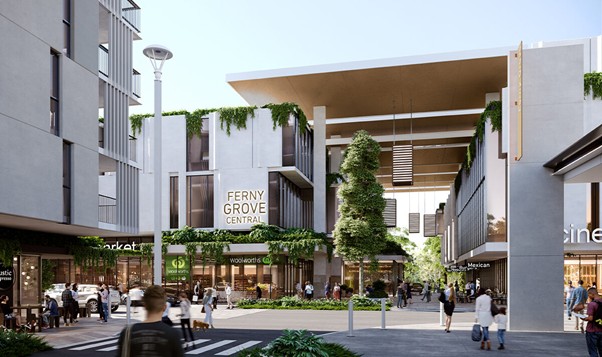
The 12,000sqm retail centre allows for a mix of different retailers, and office space. Provision has also been made to include medical practitioner service providers, and a gym.
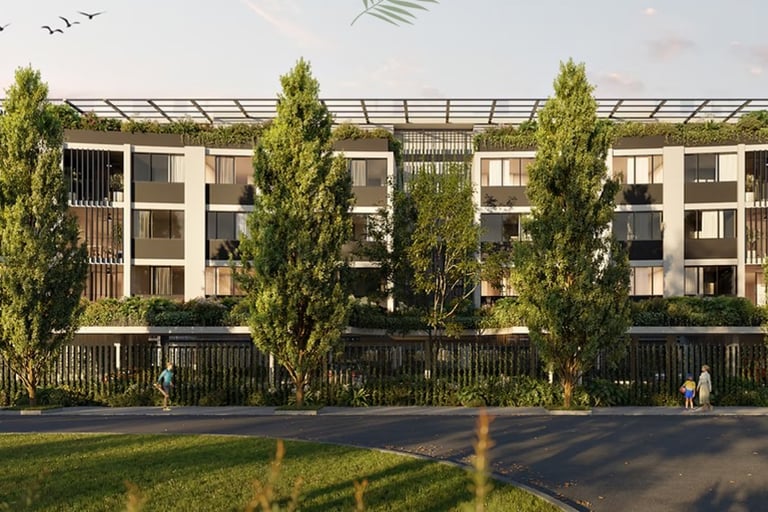
The Fernery is the residential development at the Ferny Grove site, featuring 82 one-, two- or three-bedroom apartments.
Thomas Nash, formally a Wellington regional councillor and transport chair for Greater Wellington Regional Council, is researching Transit Oriented Development. Thomas notes that ‘Railway stations are the anchor points for some of the world’s most beautiful, accessible, exciting and well connected neighbourhoods, often hugely desirable places for people to live and work.’
In 2021, New Zealand’s Ministry of Transport had been writing about the benefits of Transit Oriented Development.
“Transit Oriented Development (TOD) could play a key role in achieving net zero carbon emissions by 2050. It can help shape urban mobility patterns and demand through better integrating transport, land use and urban development planning.”
Well-designed hubs at Hamilton Central, Rotokauri | The Base, and within the Auckland metropolitan region, may be effectively integrated with new community railway stations at Pokeno, Tuakau, Te Kauwhata and Ngāruawāhia, as well as the current station at Raahui Pookeka | Huntly. Enhanced connectivity can support equitable development. Through enabling affordable access to education, jobs, new regional businesses, family, social events and health services, Te Huia and its successor regional passenger rail services, may play a role in encouraging more kiwis to stay in Aotearoa New Zealand.
At the recent “Stack the Station” rally, organised by the Future is Rail, advocates and passengers gathered at Frankton Station in Hamilton to support Te Huia. Tama Potaka and Ryan Hamilton, both local National Party MPs, spoke in support of higher density housing around train stations, including Rotokauri.
We explore these issues in more detail in our report Preventing another Te Huia extinction.
Case Study One: Integrating “The Base”, located at Te Rapa, and adjacent Rotokauri Transport Hub
The Base is a highly successful retail precinct located at the former site of an airforce base. The Base is owned by Tainui Group Holdings (TGH). It is operated by TGH and Kiwi Property as a 50:50 joint venture. A key investment in the Te Huia trial, is the construction of the Rotokauri Transport Hub, located beside The Base. There is considerable potential to further develop the land adjacent to the railway tracks, and in future the airspace above, as Transit Oriented Development.
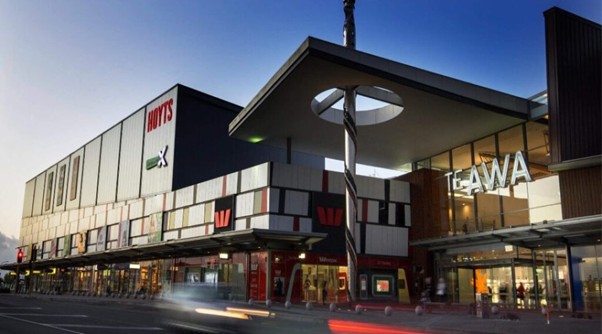
The Base is New Zealand’s largest mixed-use property asset outside of Auckland. It consists of an enclosed regional shopping centre, Te Awa, as well as large format retailing located on the site of a former airforce base at Te Rapa in growing North Hamilton.
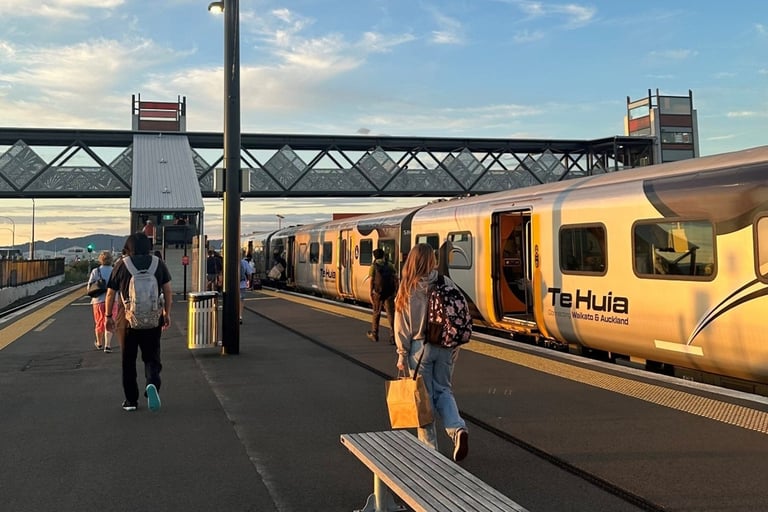
Rotokauri Transport Hub is a key station for Te Huia, and is located adjacent to The Base. A number of key ingredients are present, that can enable the further development of airspace above, and land adjacent to the railway tracks, as TOD.
Case Study Two: Inspiration for the redevelopment of Hamilton Central?
The current derelict underground railway station at Hamilton Central, is unused in its current form. Above ground, Hamilton is beginning to engage with the potential of the civic spaces above, which could be regarded as under-used. Toowong in South East Queensland, represents a successful and vibrant outcome, from an integrated Transit Oriented Development. Could central Hamilton in future, similarly be a bustling city centre with retail, community services and residential apartments, above a revitalised underground railway station?
A special feature of a revamped Hamilton Central Station will be that it will be a very convenient hub, enabling connection to the Waikato River cycle trails including Hamilton City River Trail, Te Awa River Ride , and further upstream.
The arrival of the Waikato Regional Theatre is a demonstration of Hamilton’s ambition to become an attractive visitor destination, with a diversity of musical, cultural and recreational experiences. It serves as a “placemaking” commitment to a desirable city centre of high quality, where people will want to visit, and live. This venue also has the potential to further enhance central Hamilton’s progression through Transit Oriented Development, in combination with a revamped Hamilton Central Station.
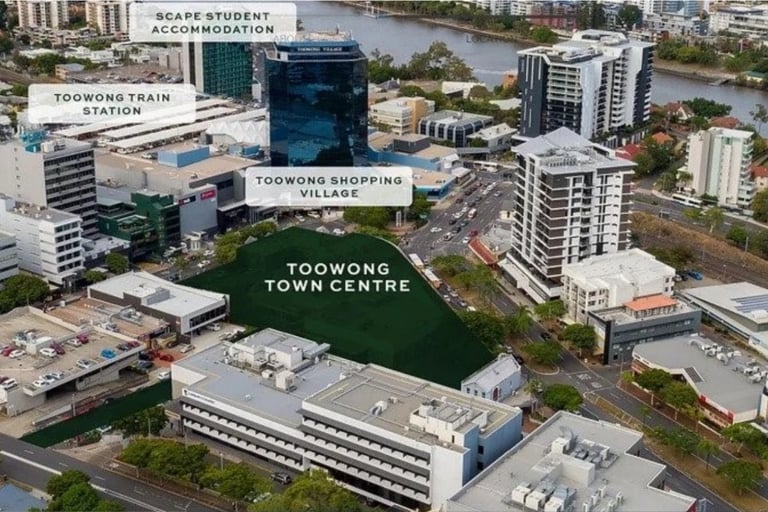
Toowong is a key station in the South East Queensland rail network. The air-space above the station is taken up by what is a very convenient shopping centre. It can be seen that in addition to administration and retail buildings, a number of multi-story apartment blocks are also adjacent to the station. “Building over” and “trenching” the railway tracks enables what is a busy passenger and freight corridor, to be accommodated within a desirable residential neighbourhood. With Brisbane River in the background as a cue; could this type of development rejuvenate the current Hamilton central railway station location, and enhance the central Hamilton precinct, adjacent to the Waikato River?