
Te Huia: rail economics in context
Te Huia has been a lightning rod for those concerned about subsidised travel. But transport subsidies is a murky area, with rail not being the only area receiving subsidies. In New Zealand, roads and aviation are big recipients of central and local government support.
POLICYWAIKATOFINANCEINVESTMENT
The Future is Rail
2/1/20262 min read
Subsidies and economics
Te Huia has been a lightning rod for those concerned about subsidised travel. But transport subsidies is a murky area, with rail not being the only area receiving subsidies. In New Zealand, roads and aviation are big recipients of central and local government support. In the area of roads, The Future is Rail has set out the significant subsidies provided to the road freight industry through them not paying the full costs of damage to roads.
As an aviation example, the upgraded Taupō airport, paid for by taxpayer and ratepayer funding, is little used with currently no scheduled direct services to Wellington. At the start of 2020, when announcing the nearly $10 million upgrade, the then Taupō District mayor David Trewavas stated ‘[w]e’ll be able to accommodate bigger planes and larger numbers of passengers coming into and out of the Taupō District; the opportunities that affords is really exciting.’
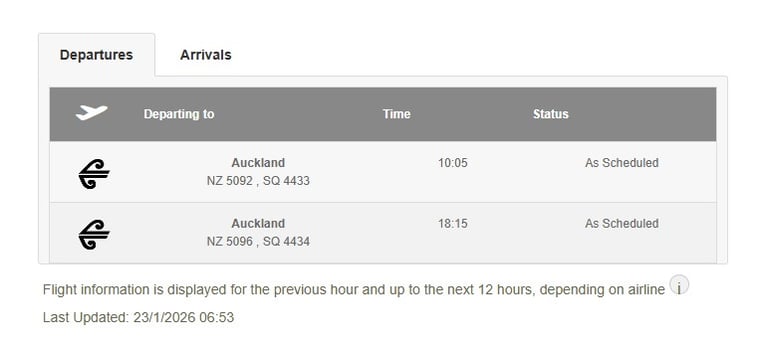
On a weekday in early 2026, there were only two scheduled flights out of Taupō airport. Yet, this does not seem to attract the criticism aimed at rail subsidies.
Domestic flights connecting to an international flight are exempt from GST, and international flights to and from New Zealand are not subject to the ETS.
The tax-payer funded Goldcard allows older New Zealanders to travel free on mainly urban based public transport at some times of day. Some councils top the subsidy up with ratepayer funding to increase the times of day this free travel applies. There are also examples of businesses subsidising public transport for their employees.


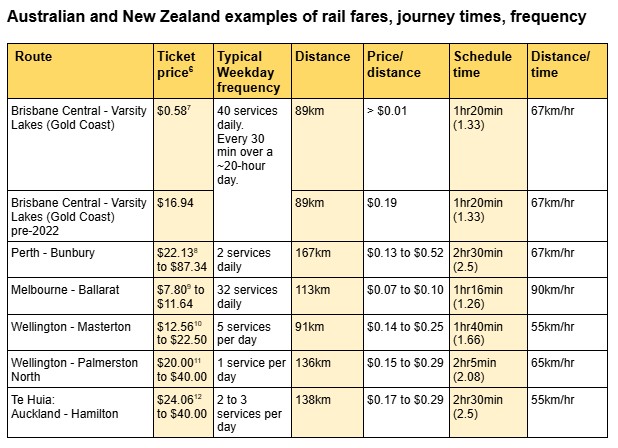
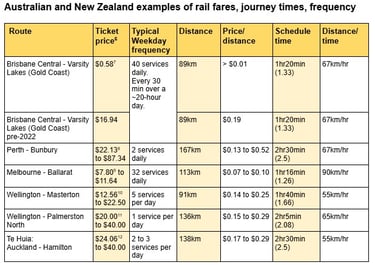
Any discussion about farebox recovery, should also provide context, as to what customers receive for a given level of operating subsidy. The below table provides some rudimentary analysis. It must be noted that trying to compare different fare types can be a challenge. The below is an indication only, with acknowledgement that there are different types of fare for different passenger user groups, and/or multi-trip ticketing concessions, that may significantly change pricing.
Frequency of service is another factor that provides a hint of the level of OPEX, that may impact farebox recovery. Journey time and average speed relative to competing modes, can also impact on the sorts of fares able to be charged to attract passengers.
We explore these issues in more detail in our report Preventing another Te Huia extinction.